Who Was Moulay Idriss?
The town takes its name from Moulay Idriss I, a great-grandson of the Prophet Muhammad who fled political upheaval in the Middle East and arrived in Morocco in 789 AD. He is credited with founding the Idrisid dynasty, Morocco's first Islamic ruling dynasty, and with spreading Islam through the region. After his death, his tomb became — and remains — one of the most important pilgrimage sites in Morocco, drawing visitors from across the country, particularly during the annual moussem (religious festival) held in his honor.
A Town Built Across Two Hills
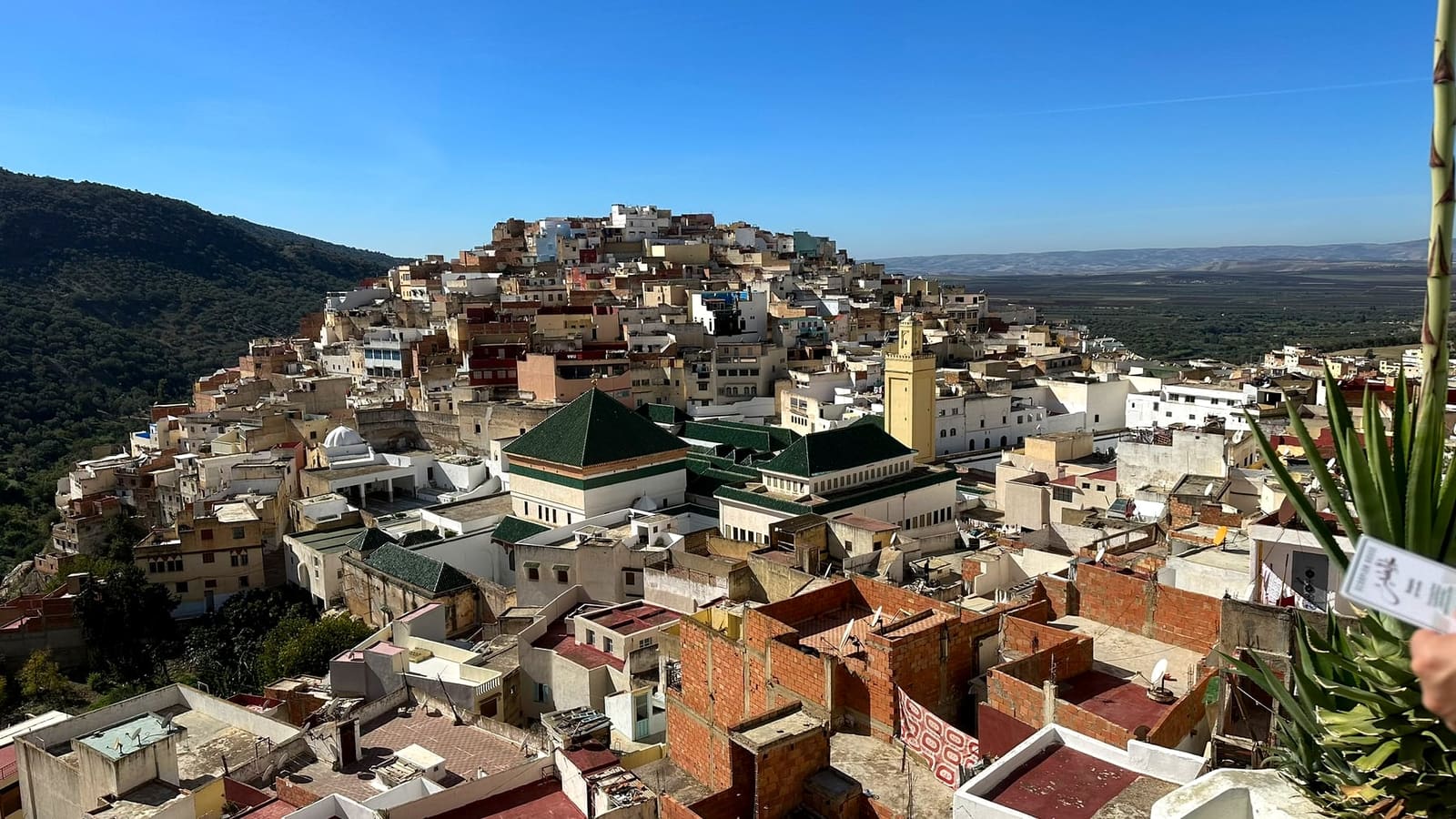
Moulay Idriss is built across two hillsides, traditionally referred to as Khiber and Tasga, separated by a saddle where the town's main square and the mausoleum sit. Whitewashed houses climb both slopes in tightly packed lanes, giving the town a distinctive layered look from a distance, similar in spirit to Chefchaouen but without the blue. A short climb to a terrace on one of the hillsides offers a panoramic view over the rooftops and, on a clear day, out toward Volubilis in the valley below.
Visiting as a Non-Muslim
Moulay Idriss was closed to non-Muslim visitors until 1912, and even after opening was long considered off-limits to outsiders after dark. Today it welcomes visitors freely during the day, though — as with virtually all active religious shrines in Morocco — the mausoleum itself, housing Moulay Idriss I's tomb, remains closed to non-Muslims. Visitors are welcome to walk the town's lanes, visit the main square, and view the mausoleum's green-tiled roof and courtyard from outside.
What to See and How Long to Stay
Moulay Idriss is small enough to explore on foot in an hour or two — enough time to wander the lanes, take in the viewpoint, and get a sense of the town's layout and quiet, devotional atmosphere. Most visitors combine it with nearby Volubilis as a half-day trip, spending the morning among the Roman ruins and the early afternoon in Moulay Idriss, or the reverse, before continuing on to Fes, Meknes, or Chefchaouen.